
2,847 creators joined this month
Grow your 𝕏 audience 3x faster
AI writing, viral tweet library, smart scheduling, and lead finder. All in one tool.
Try Tweet Hunter for free7 day free trial - Money back guarantee
Most people who struggle to grow on Twitter have the same problem. They do not know what to tweet.
Monday they post about productivity. Wednesday they share a meme. Friday they rant about a news story. Nothing connects. Nothing compounds.
Twitter content pillars fix that.
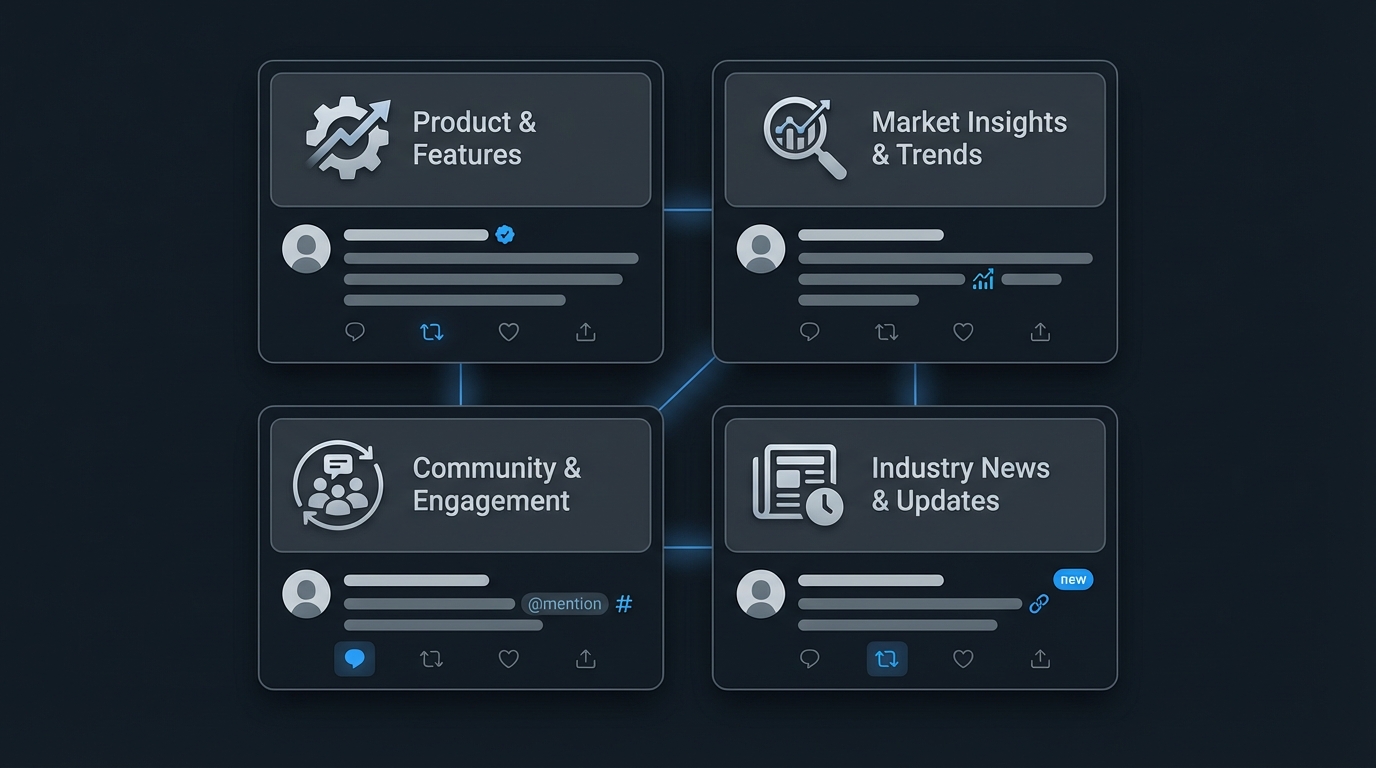
Content pillars are 3-5 recurring themes that anchor everything you post.
They are not just topics. They are the areas where your expertise, your audience's interests, and your goals all overlap. Every tweet, thread, and reply you send connects back to at least one of them.
A founder building in public might have these pillars:
A freelance designer might have:
When you see someone and immediately know what they are about, that is content pillars working in the background.
Random posting feels productive in the moment. You are tweeting. You are showing up. But without structure, a few things go wrong.
First, your audience does not know what to expect from you. If someone follows you for startup advice and then gets three tweets about cooking, they tune out or unfollow.
Second, the Twitter algorithm clusters accounts by topic. When you post about everything, the algorithm does not know who to show your content to.
Third, you cannot build a reputation in any specific area. Influence on Twitter comes from repetition.
Not what sounds impressive. What you actually know from experience.
Some prompts:
Look at who you want to reach and what they are struggling with. Go to accounts in your space that already have audiences. Look at their most engaged tweets. What topics get comments?
The sweet spot for a pillar is where what you know intersects with what they actually want to learn.
Pick your best candidates and run a real test. Post 3-4 tweets per topic over a two-week window and track what happens.
Analyzing your tweet performance during this period is essential.
After two weeks, one or two topics will have clearly outperformed the others. Pick the best one and commit.
Three to four pillars is the right number for most people. Five is the maximum. More than that and you are back to random posting with extra steps.
A basic framework for a 5-tweet week:
Using a Twitter scheduling tool to plan your week in advance makes this even easier.
After 30 days of consistent posting, check for these signals:
If none of that is happening, either your pillars are not hitting the right intersection, or your execution needs work. Go back and look at your top-performing tweets.
Having great pillars does not help if you are not consistent. TweetHunter is built for this. You can use AI writing tools to generate tweet ideas within each of your pillars, schedule your weekly content in advance, and use analytics to track which pillars are driving the most engagement.
The accounts that grow fastest on Twitter are the most consistent. Pillars give you the structure. TweetHunter gives you the tools to actually stick to it. Start for free at tweethunter.io.
AI writing, viral tweet library, smart scheduling, and lead finder. All in one tool.
Try Tweet Hunter for free