
2,847 creators joined this month
Grow your 𝕏 audience 3x faster
AI writing, viral tweet library, smart scheduling, and lead finder. All in one tool.
Try Tweet Hunter for free7 day free trial - Money back guarantee
If you've spent any time in Twitter growth communities, you've heard about engagement groups. Sometimes called engagement pods. A group of accounts that agree to like, reply, and retweet each other's content to boost its early performance.
The pitch is simple: more early engagement means the algorithm distributes your tweet more broadly. And that part is true.
But here's the full picture.
An engagement group is typically organized in a private space - a group DM on X, a Discord server, a Slack channel, or a WhatsApp group. Members post their tweet links in the group, and other members agree to engage with that content within a set time window (usually the first 30-60 minutes after posting).
The mechanics vary. Some groups are informal "I'll like yours if you like mine" arrangements. Others have specific rules: you must comment substantively, you must retweet with quote, you can only participate X times per week.
These groups are common in nearly every niche on X. Creator Twitter, Marketing Twitter, Personal Finance Twitter, B2B SaaS Twitter - if there's a community, there's probably an engagement group.
The X algorithm weighs early engagement heavily when deciding whether to distribute a tweet more broadly. A tweet that gets 10 replies and 5 retweets in the first 30 minutes performs significantly better in terms of reach than one that gets zero engagement in the first hour, even if both tweets are identical in content quality.
This creates an obvious incentive structure. If you can manufacture that initial engagement signal, you can get better distribution. And for new accounts trying to break through with no established audience, pods seemed like a logical shortcut.
For a while, they worked reasonably well.
The landscape has shifted. Here's why engagement pods are a diminishing-return strategy and, in some cases, an actively harmful one.
X's algorithm has gotten better at detecting coordinated engagement. The same patterns that make pods effective also make them detectable: multiple accounts engaging with the same content in tight time windows, at unusual times, from accounts that consistently engage with each other but not with the broader community. X's systems flag these patterns.
Pod engagement doesn't convert. The people liking your tweet from a pod don't actually care about your content. They're not going to follow you, click your links, or share your content organically. You get the metric but not the outcome the metric was supposed to represent.
It trains the algorithm to show your content to the wrong people. X uses engagement signals to understand who your content is for. If everyone engaging with your tweets is from a pod of growth marketers, but you're actually trying to reach HR professionals, you're teaching the algorithm to show your content to the wrong audience.
Your reputation is at risk. The X community is observant. If you consistently get high engagement on content that doesn't seem to warrant it, people notice. Especially journalists, competitors, and potential partners who might look at your analytics.
Quality pods are hard to find. The good engagement groups are private, invite-only, and require genuine reciprocal investment. Most of the pods that new users can easily find are low-quality, full of inactive accounts, or full of people gaming the system without producing real engagement.
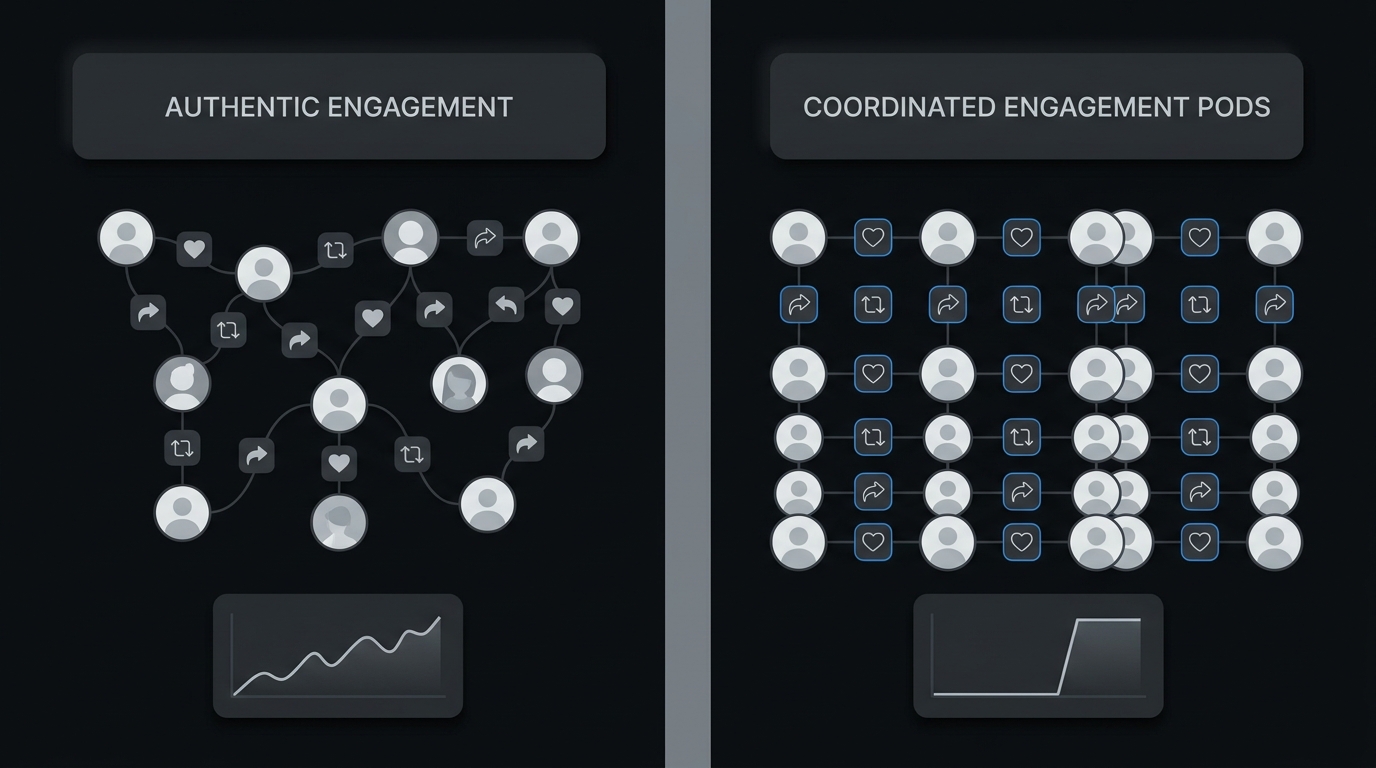
Not all coordination is manipulation. There's a meaningful difference between an engagement pod and a genuine community.
Legitimate collaboration: A group of 10 newsletter creators in the same niche who read each other's work, share it when it's genuinely good, and comment with real perspectives. That's community, not manipulation.
Legitimate coordination: A team of people at the same company who each share a major announcement and engage with each other's posts because they all actually care about the announcement. That's a team, not a pod.
The line to draw: Would you be comfortable if X could see exactly what was happening in this group, and why? If the answer is yes, you're probably in a legitimate collaboration. If not, you're in a pod that carries risk.
The pods that continue to deliver value are those in which the participants genuinely find each other's content interesting and would engage with it anyway. The coordination is about timing and prioritization, not about manufacturing fake engagement.
If you want early engagement on your tweets, the sustainable paths are all variations on the same theme: build real relationships and produce content worth engaging with.
Build actual relationships before you need them. The best "pod" is a network of people you've built genuine relationships with over time, who follow your work and engage when they find something valuable. This doesn't require a group DM. It requires months of showing up, adding value to others' conversations, and building trust.
Reply strategy. Consistently replying with quality insights to accounts in your niche is the most reliable way to build the kind of mutual respect that leads to organic early engagement. When you post and 10 people who've had good conversations with you see it, they'll engage naturally.
Notify your most engaged followers. If you have regulars who almost always engage with your content, sending them a friendly heads-up via DM when you post something you're proud of isn't manipulation - it's relationship maintenance. "Hey, I just posted a thread I think you'll find useful" is fine. A group DM demanding likes is not.
Post when your audience is active. The simplest lever for early engagement is timing. Post when the specific people who follow you are most likely to be on X. TweetHunter's analytics will show you exactly when your audience is active, so you're not posting into a void.
Write better hooks. The fastest way to improve your early engagement is to write opening lines that stop people mid-scroll. A tweet that interrupts someone's scrolling with genuine curiosity or tension will generate organic engagement that no pod can replicate.
Engagement groups, at their worst, are a shortcut that shortcuts nothing. You get metrics without outcomes. You train the algorithm to be wrong. You build a following that doesn't actually care about you.
The accounts on X that have built durable, valuable audiences have almost universally done it the slow way: consistent posting, genuine community engagement, quality content, real relationships.
That path takes longer. But it produces something a pod can't: followers who are actually there for you, who share your work because they find it valuable, and who eventually become customers, collaborators, and advocates.
TweetHunter is built around accelerating that path - not circumventing it. The tools that help you post consistently, find the right engagement timing, understand what your audience responds to, and maintain relationships with your most valuable followers are all aimed at building real growth.
Not inflated metrics that evaporate when you stop pumping them.
Engagement groups are tempting because growth is hard and slow. But the shortcuts that don't work waste your time. The shortcuts that work temporarily often set you back long-term.
Build real relationships. Write content worth sharing. Show up consistently.
That's still the answer in 2026.
Try TweetHunter free and build a Twitter audience that actually means something.
AI writing, viral tweet library, smart scheduling, and lead finder. All in one tool.
Try Tweet Hunter for free