
2,847 creators joined this month
Grow your 𝕏 audience 3x faster
AI writing, viral tweet library, smart scheduling, and lead finder. All in one tool.
Try Tweet Hunter for free7 day free trial - Money back guarantee
Creating new content from scratch every day is exhausting. It is also unnecessary.
The most consistent creators on Twitter are not the ones with the most original ideas. They are the ones who know how to extract maximum value from every idea they have.
Repurposing content for Twitter means taking something you already made - a blog post, a podcast episode, a YouTube video, a newsletter, or even a strong tweet - and turning it into multiple pieces of Twitter content.
This guide shows you how to do it systematically.
Before getting into tactics, understand why this works:
Most of your audience misses most of your content. Twitter's feed is fast. Even your most engaged followers see only a fraction of what you post. Repurposing the same idea in different formats means more people encounter it - and different people respond to different formats.
Ideas are the hard part. Reformatting is easy. If you already did the thinking, the research, and the writing for a blog post, you have done 80% of the work. Adapting it for Twitter is a small effort with significant return.
Repetition builds authority. When people see you come back to the same themes from multiple angles, they start associating you with that topic. Consistency of message is how experts are recognized.
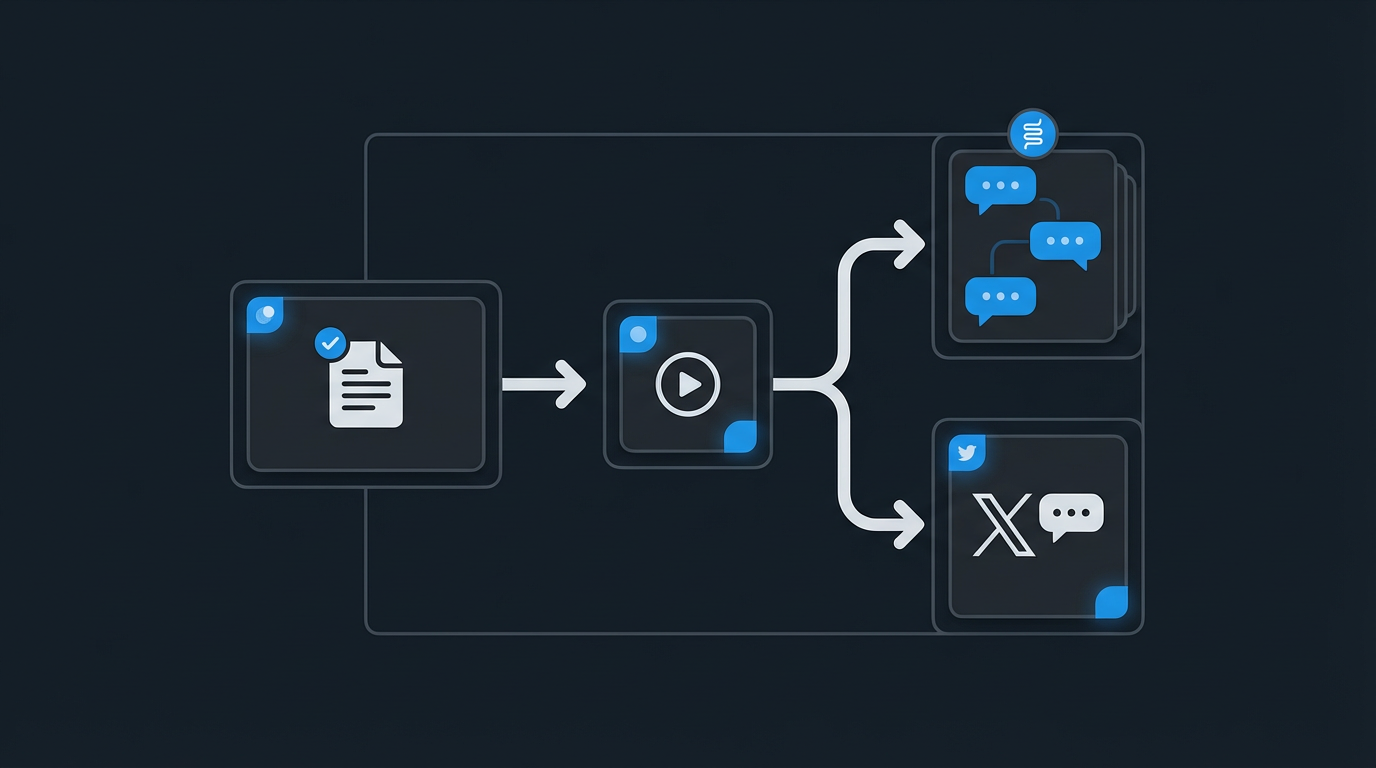
Stop thinking about content as a single piece. Think of every idea as a content asset that has multiple expressions:
Every time you create something, ask: what are the 3 to 5 most valuable points here? Each one is a tweet.
Blog posts are the richest source of Twitter content because they are already structured and long-form.
Step 1 - Extract the key insights
Read through your post and highlight every insight, stat, framework, or counterintuitive point. Each one is a potential tweet.
Step 2 - Write a thread version
Take the top 5 to 8 insights and turn them into a numbered thread. The first tweet is a hook that promises the value of the whole post. Each subsequent tweet is one insight, explained briefly. The last tweet links back to the full article.
Example structure:
Step 3 - Write standalone tweets
Not every insight works as a thread item. Some are better as standalone one-liner tweets, opinion posts, or questions.
Take the most provocative point from your post and turn it into a bold claim tweet: "Most people think [X]. They are wrong. Here is why:"
Step 4 - Create a poll from your data
If your post contains research or stats, turn a surprising finding into a poll: "What do you think is the average [X]?" Then reveal the answer in a reply. Polls drive high engagement and profile discovery.
Step 5 - Quote your own post
Pick the best sentence from your post and tweet it as a standalone quote, then add context in the replies or as a thread.
Newsletters and Twitter have a natural overlap: both are built around insight and voice.
The preview tweet: Before you send your newsletter, post a tweet that teases the main insight without giving it away. "This week's newsletter covers [topic]. The stat that surprised me most: [stat]. Full breakdown in your inbox tomorrow."
Post-send tweets: After the newsletter goes out, post 2 to 3 tweets over the following week that expand on individual points. These drive signups from people who want to get the full version.
The best line tweet: Find the single best sentence in your newsletter and post it as a standalone tweet. No context needed - just the line.
The retrospective: A few months after a strong newsletter issue, revisit the topic and post an update: "I wrote about [topic] 3 months ago. Here is what I got right, what I got wrong, and what changed:"
Podcast content is underused on Twitter. Most podcasters just post a link and hope for clicks. There is a much better approach:
Quote tweets from the episode: Identify 3 to 5 memorable lines or insights from the conversation. Post each one as a tweet over 2 to 3 weeks, with the episode link.
The summary thread: Write a 5-tweet thread summarizing the best insights from the episode. This is the fastest way to convey value to people who will never listen to the full episode - and to earn clicks from the ones who want more.
The question expansion: If your guest made a strong point you want to explore further, tweet a question that opens it up to your audience: "[Guest] said [insight] on my podcast this week. Do you agree? My take:"
Repurposing is not just about going from long-form to short. Sometimes a single tweet that performs well is telling you something - your audience cares about this topic. Expand it.
Turn a viral tweet into a thread: If a tweet gets significantly more engagement than usual, that is a signal. Write a thread that goes deeper on the same topic.
Turn a tweet into a blog post: A tweet that sparks a lot of replies often has enough material to become a full article. The replies tell you which sub-topics your audience wants to explore.
Cross-post to LinkedIn: Your best Twitter threads often work well on LinkedIn with minimal adaptation. What performs on one platform usually resonates on the other because the underlying insight is strong.
Here is a simple process you can run once a week in under an hour:
Monday: Review the week's newsletter or blog post. Pull 5 key insights. Write 5 tweets.
Tuesday-Thursday: Post one tweet per day from last week's batch.
Friday: Check which tweets performed best this week. Identify the top performer. Start planning the thread that expands it.
Weekend: Write the thread for next week. Prep the next newsletter pull.
This creates a flywheel: good content generates data, data tells you what to expand, expanded content generates more good material to repurpose.
TweetHunter is built for this workflow. You can:
The AI writing feature is particularly useful for repurposing - paste in a blog post excerpt and ask it to reformat as a tweet or thread. It learns your voice and style, so the output sounds like you.
Notion or a notes app works for maintaining a content bank: a running list of ideas, published posts, and tweets ready to repurpose.
Not everything should be repurposed. Avoid:
Every time you publish something new, run through this:
Answering these questions takes 10 minutes. The result is weeks of content from a single piece of work.
You probably have months or years of content sitting in your blog, newsletter archives, or podcast feed right now. Every one of those pieces is a source of Twitter content you have not tapped yet.
Start with your single best-performing piece of content. Pull 5 insights. Write 5 tweets. Schedule them across the next week.
That is it. You just created a week of Twitter content from something you already made.
TweetHunter makes this even faster - its AI can help you transform any long-form content into tweets, threads, and hooks in minutes. Try it free at tweethunter.io.
AI writing, viral tweet library, smart scheduling, and lead finder. All in one tool.
Try Tweet Hunter for free